
Sri Lanka-Korea Business Council puts spotlight on ‘Sri Lanka’s Future – Forecast, Scenarios and Challenges’
The tension between the pursuing headline economic growth and establishing genuine long-term stability took centre stage recently, as the leading economists and corporate leaders debated the trajectory of Sri Lanka’s post-crisis recovery.
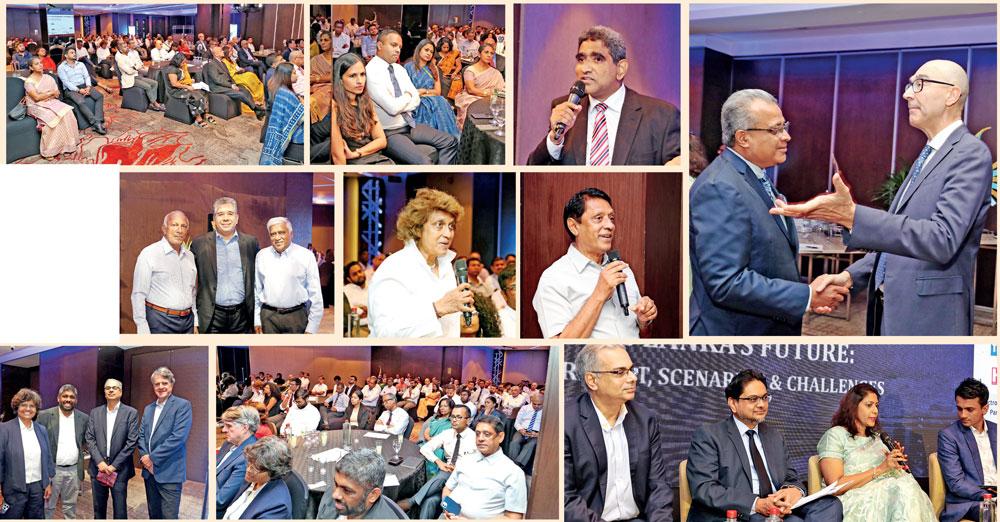
Hosted by the Sri Lanka-Korea Business Council of the Ceylon Chamber of Commerce, at Hilton Colombo Residences, the panel discussion titled ‘Sri Lanka’s Future – Forecast, Scenarios and Challenges’ laid bare the deep divisions over the macroeconomic planning, debt rollover risks, international credit ratings and structural reforms required to prevent another sovereign default.
Beneath the granular debate over the interest rates and credit ratings, one question kept resurfacing: whether growth alone can rescue Sri Lanka or whether it will take a deeper overhaul of governance and institutional accountability to make that growth durable.
As part of its flagship event series, the council organised the forum to provide a comprehensive analysis of Sri Lanka’s economic outlook, in the context of the evolving domestic developments and an increasingly dynamic global and geopolitical landscape.
The event introduced a novel structure, featuring two comprehensive keynote presentations, followed by an interactive format that paired a primary panel of industry leaders alongside a dedicated reaction panel. This unique mechanism was specifically integrated to fine-tune the economic debate, heighten panel preparation and drive optimal policy conclusions.
Setting stage for economic recovery
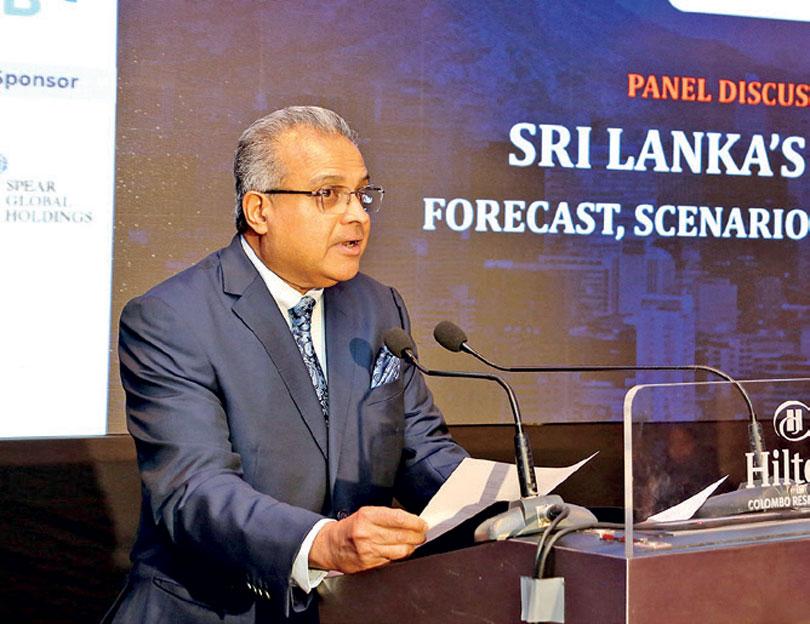
Sri Lanka-Korea Business Council President Shamil Mendis
Delivering the welcome address, Sri Lanka-Korea Business Council President Shamil Mendis outlined the broader context of the gathering, reflecting on the council’s ongoing initiatives to foster a growing partnership between the business communities of the two nations.
Following the first edition of this economic discussion held in 2024, Mendis observed that much has occurred across a volatile domestic and international operating environment.
“Sri Lanka is at an important stage in its economic journey. We have seen encouraging signs of recovery but at the same time, the path ahead will bring both opportunities and challenges. We have to maintain stability and we have to grow our economy at the same time,” Mendis stated.
“For the business community, looking towards the future is not only about understanding economic forecasts or predicting numbers. It is about asking what different scenarios could emerge, how they may affect the economy and businesses, what risks we need to be prepared for and where new opportunities may arise. This is exactly why platforms such as today’s discussion are important,” he added.
Mendis explained that the session was designed to draw out unvarnished assessments, reminding the participants that the true value of the discussion would be determined by not holding back on what they really feel.
The high-profile event drew senior diplomatic representation, including the Ambassador for Italy, Ambassador for Türkiye and High Commissioner of Canada. Notably, it marked the final public appearance of Ambassador for the Republic of Korea Miyon Lee, who attended the session just hours before taking a flight to her next diplomatic posting.
“Ambassador Miyon Lee bids farewell to us as she completes her tenure in Sri Lanka. In fact, she takes a flight to her next posting tonight,” Mendis said, thanking her for her support of the council’s work.
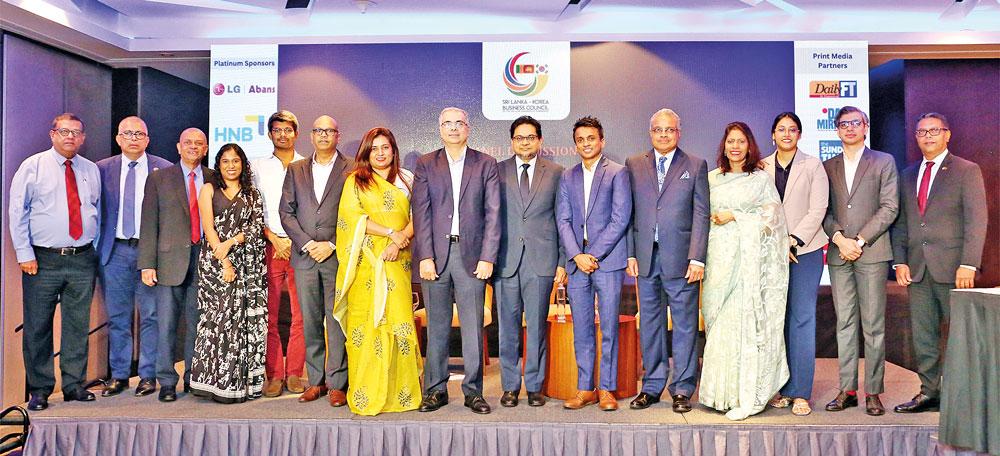
Following the opening remarks, the session transitioned into its core technical segment, anchored by two foundational keynote presentations delivered by Verité Research Executive Director Dr. Nishan de Mel and Advocata Institute Chairman Murtaza Jafferjee. Their presentations laid the groundwork for the subsequent discussion, which brought together the main panel featuring Dr. de Mel, Jafferjee and Global Consulting Company CEO Aroshi Nanayakkara. They were joined by a reaction panel comprising The Examiner CEO Daniel Alphonsus, CAL Holdings Group CEO Kanishka Mannakkara and Arutha Co-Founder and Director Rehana Thowfeek, with Advocata Institute CEO Dhananath Fernando serving as the moderator.
Misunderstood trajectories and wealth transfers
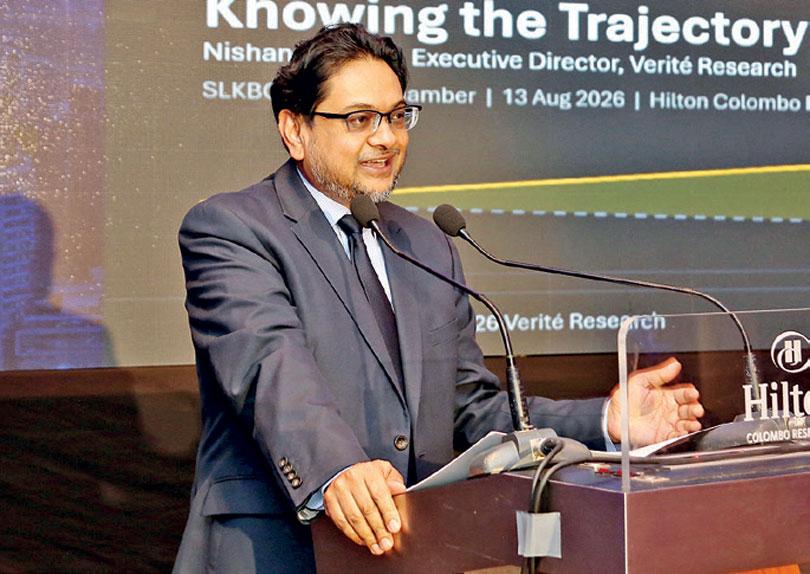
Verité Research Executive Director Dr. Nishan de Mel
Setting the analytical tone in the first keynote presentation, Dr. de Mel drew a historical parallel between Sri Lanka’s macroeconomic planning and Christopher Columbus’ voyage across the Atlantic.
In the late 15th century, Columbus set off from Europe destined for India but a fundamental misunderstanding of his trajectory landed him in the Caribbean instead.
“In the 1500s, all of Asia was known as the Indies. Christopher Columbus in 1490 or so set off from Europe to India but due to a navigation error, he landed in the Caribbean,” de Mel observed.
“Even though he knew exactly where he wanted to get to, he wasn’t quite sure of his trajectory; it turned out and ended up in quite a different place.”
Dr. de Mel cautioned that Sri Lanka risks a similar catastrophic outcome by anchoring the national policy to the flawed economic projections published in the official government and International Monetary Fund (IMF) review documents.
He presented empirical evidence demonstrating that the official review documents have consistently published macroeconomic forecasts that diverge sharply from the ground reality. The official projections for the current account persistently anticipated severe deficits, yet the actual outcomes produced substantial surpluses.
Similarly, the official documents imputed foreign exchange rates climbing past Rs.460 and Rs.510 to the US dollar, even as the market dynamics held the rupee far stronger. Furthermore, while the yield curve predicted in the debt sustainability assessments assumed the borrowing costs around 300 basis points below the actual market yields, economic growth outperformed the official projections.
Dr. de Mel stressed that these forecasting errors distort fiscal planning, recalling how the authorities delayed domestic debt restructuring in 2022, despite the clear warnings, ultimately saddling the Treasury with elevated domestic interest obligations.
This navigation problem is most acutely visible in the Central Bank of Sri Lanka’s management of inflation. Under the prevailing monetary framework, the Central Bank is legally bound to anchor headline inflation at 5 percent. However, for eight consecutive quarters, official inflation consistently undershot this target, often slipping into the deflationary territory.
Dr. de Mel argued that this persistent failure fundamentally alters the debt sustainability dynamics. In domestic debt management, inflation serves as an implicit mechanism that lowers the real burden of government interest payments. When the state pays elevated nominal yields while inflation drops to near zero, the real interest rates spike to historically volatile levels.
The direct consequence of this mismatch has been an enormous and regressive redistribution of wealth.
“When the government pays high interest and there is no inflation, what you call the real interest rates in Sri Lanka became amongst the highest in the region and also became extremely volatile,” Dr. de Mel explained.
“When you have high interest rates and no inflation, the only people that benefit from it are people like us, who have large savings, can leverage and borrow and we make money for nothing. While all the people who are living at subsistence, are just managing on wages, are paying higher taxes—18 percent VAT—so the government can collect that money and pay us the high real interest rates,” he continued.
“This is a racket in which people like us benefit enormously on the backs of those who see very little benefit from the economy.”
Dr. de Mel criticised the monetary authority for misdiagnosing the economic shocks and highlighted a breakdown in institutional accountability.
“We got it wrong on both ends. We had a sustained negative supply-side shock that we didn’t respond to by reducing the interest rates, which we should have, to stimulate demand. But when we had a negative supply shock that’s basically transient, we intervened by jacking up the interest rates 100 basis points,” he noted.
“Once you get into a gazetted agreement with the government to deliver a certain level of inflation, you have to meet that. There is no management discretion here. These are simple facts of accountability and competence. In the Bank of England, as in Sri Lanka, we’ve set up a device that says if you miss it by a certain amount, you must go to Parliament and explain why you did it. We haven’t been able to get Parliament to ask good enough questions to rectify the problem,” Dr. de Mel pointed out.
“The Central Bank failing for eight quarters in a row on a single target that it is legally mandated to do, tells you how seriously we must look at this problem of competence, because it is one of the most competent institutions we have and yet, there we have it.”
Productivity gaps and demographic headwinds
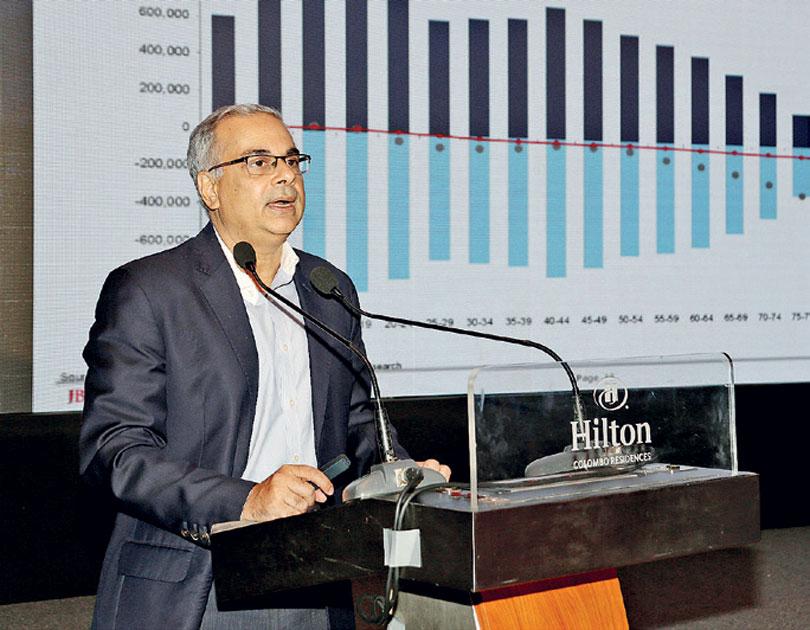
Advocata Institute Chairman Murtaza Jafferjee
Delivering the second keynote presentation, Jafferjee focused on the structural bottlenecks inhibiting the economic output, complexity of Sri Lanka’s export basket and an impending demographic crisis. Jafferjee emphasised that sustainable economic expansion cannot rely on debt-fuelled consumption but must be driven by productivity, competition, trade liberalisation and shrinking the state-owned enterprise footprint.
Utilising the Harvard Atlas of Economic Complexity, Jafferjee contrasted Sri Lanka’s stagnant product space with that of the regional peers. While nations like Vietnam expanded their exports from US $ 15 billion in 1998 to nearly US $ 450 billion by aggressively adding complex manufactured goods, machinery and electronics to their trade baskets, Sri Lanka’s exports have remained narrowly confined to garments, tea and rubber. He stressed that economic complexity requires tacit knowledge, which is acquired either through foreign direct investment or by actively mobilising the skilled diaspora.
Jafferjee then presented the sobering demographic data, warning that Sri Lanka is facing a sharp demographic contraction that would hollow out its future workforce. The annual births have plummeted from roughly 370,000 in the post-conflict period to just 240,000 last year, creating an impending contraction across primary schooling, higher education and labour market.
Furthermore, the census data reveals a missing generation between the ages of 25 and 35, where nearly 20 percent of the population cohort has emigrated, due to a lack of domestic economic opportunity.
Compounding this problem is the chronic underutilisation of women in the workforce. Despite the females accounting for 52 percent of the population and outperforming the males in educational attainment, the female labour force participation remains stagnant at just 32 percent. Overall total factor productivity growth has remained negative, with millions of workers trapped in low-output agricultural and informal service jobs.
Jafferjee also pointed to the severe income compression facing the workforce, noting that roughly 92 percent of formal private sector employees now earn less than Rs.100,000 a month.
To address these systemic productivity deficits, he proposed rationalising the national holiday calendar. He noted that Sri Lanka observes roughly 18 weekday public holidays alongside nine three-day weekends, creating substantial business downtime.
He proposed converting redundant public holidays into contractual leave days while raising worker compensation to incentivise output.
Implementation paralysis frustrates reaction panel
The Examiner CEO Daniel Alphonsus
Following the keynote presentations, Fernando opened the floor to the reaction panel, where a recurring frustration surfaced before the discussion even turned to specifics: the persistent gap between diagnosis and action.
Alphonsus captured the exasperation, arguing that Sri Lanka’s economic remedies have been common knowledge for decades without ever being enacted.
“We’ve heard this again and again and again for the last couple of decades. So, it’s not that this is not known by everyone in the room,” Alphonsus said.
“The question I think we should direct our attention to during this conversation is why, despite knowing this, we haven’t done anything serious about it and what we can do now.”
Thowfeek echoed the sentiment, questioning why the widely-acknowledged structural reforms remain stalled more than three years after the crisis.
“We all know that Sri Lanka has to export more. We all know that we need to open up; we need to become more competitive. But why has that not happened?” she asked.
“Three and a half years later, we are saying this is the time to reform but why haven’t these reforms taken place?”
Debating inflation and debt rollover risks
CAL Holdings Group CEO Kanishka Mannakkara
The debate then sharpened around monetary policy specifics. Mannakkara offered a contrasting perspective, arguing that lower price levels should be welcomed rather than treated as a regulatory failure.
“I think having low inflation is a good thing. High inflation is a double-edged sword. It’s tempting to think of inflation as this tool through which you can inflate away your problems but that doesn’t create long-term sustainability. So, I feel that if anything we should be looking at lower inflation targets,” Mannakkara stated.
“Here, it’s not about personal consumption; this is about business. Lower interest rates make investment feasible and that’s what will drive dynamism in this economy.”
Mannakkara argued that reducing the lending rates requires patience, pointing out that the borrowing costs have fallen by over 20 percentage points from their peak three years ago. He suggested that the authorities formally consider lowering the statutory inflation target to between 4 and 5 percent.
Joining the discussion, Alphonsus observed that wage elasticity could provide policy flexibility, suggesting that in the absence of political will to reform the civil service, allowing inflation to compress real public sector wages might make state jobs less attractive and encourage voluntary exits. Mannakkara vehemently rejected this view, asserting that intentionally degrading public sector working conditions through inflation is an ineffective and lazy approach to state restructuring.
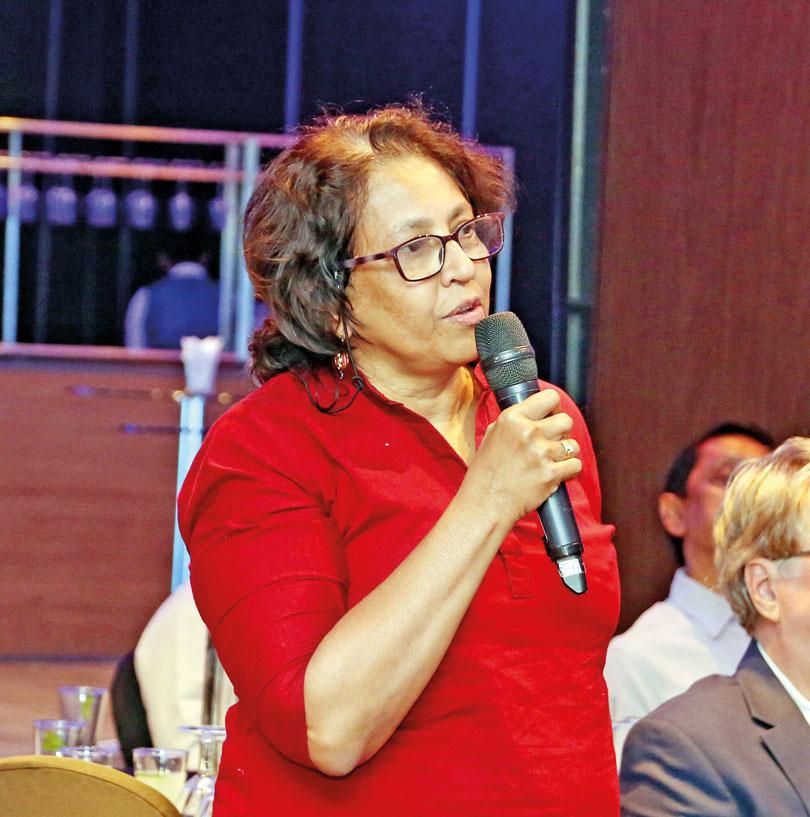
The exchange echoed a challenge raised from the floor earlier in the session, when a member of the audience cautioned against the Central Bank’s rigid pursuit of its 5 percent target, regardless of the shocks buffeting the economy, warning that forcibly pinning down a variable, driven by external forces, risked destabilising the wider economy and arguing that the authorities should tolerate inflation temporarily rising above the target when severe shocks push the prices up.
Dr. de Mel agreed with the critique. He acknowledged that the Central Bank had failed to correctly read the transient nature of the supply shock at the time and that raising the interest rates in response, rather than easing them, had been the wrong call — a misjudgement, he said, that carried destructive knock-on effects across the broader economy.
Turning to external debt, Jafferjee delivered a stark assessment of the refinancing wall awaiting Sri Lanka between 2028 and 2029, when the grace periods expire and commercial repayments resume. Jafferjee stressed that the sovereign credit ratings will exclusively determine whether the country can roll over its debt or face renewed default.
“There are three people who will determine whether we will need a restructuring or not. They have names: Moody’s, S&P and Fitch. They are rating agencies. Our destiny is in their hands,” Jafferjee stated.
“S&P did a rating review and we are CCC+. Now if you take the secondary market yields of all these bonds, they’re still trading at about 8.5 percent. If you go to the primary market, you’re borrowing at 9 percent. The highest we have ever borrowed for international finance is about 7.4 percent.”
Jafferjee explained that global capital markets operate on rollover assumptions rather than full capital recovery.
“Having served on one bank previously and another bank now, no financial institution ever wants you to pay them back, because they have a problem: what do they do with the money? What they want you to do is to remain solvent, so that the probability of you defaulting on them is low,” he said.
“When you are in CCC+, which is just one notch above selective default, you are on shaky grounds. If you look at our debt rollover challenges that are coming from 2028 to 2029, unless we significantly improve our rating, our ability to roll over our debt by borrowing in international markets is going to be very, very difficult.”
He added that the elevated US interest rates, with the 10-year Treasury yield hovering near 4.6 percent, compound these severe refinancing hurdles.
This external vulnerability led Fernando to poll the reaction panel on whether Sri Lanka would inevitably need a subsequent IMF programme or face a second debt restructuring before 2031. The panellists dismissed the likelihood of another debt restructuring before 2031 but opinions diverged on what the future IMF engagement would look like.
Mannakkara questioned the motivation behind it, asking: “Are you talking about an IMF programme that we are forced to go into or one that we desire to go into for governance reasons? Because they are two very different things.”
Jafferjee drew a technical distinction between full conditional programmes and targeted financing facilities, noting: “There’s a difference between an IMF programme and IMF financing. The Rapid Financing Instrument we did is a financing programme. I would advocate the same for financing from the IMF. I think a programme is quite unlikely.”
Vested interests, holidays and case for human flourishing
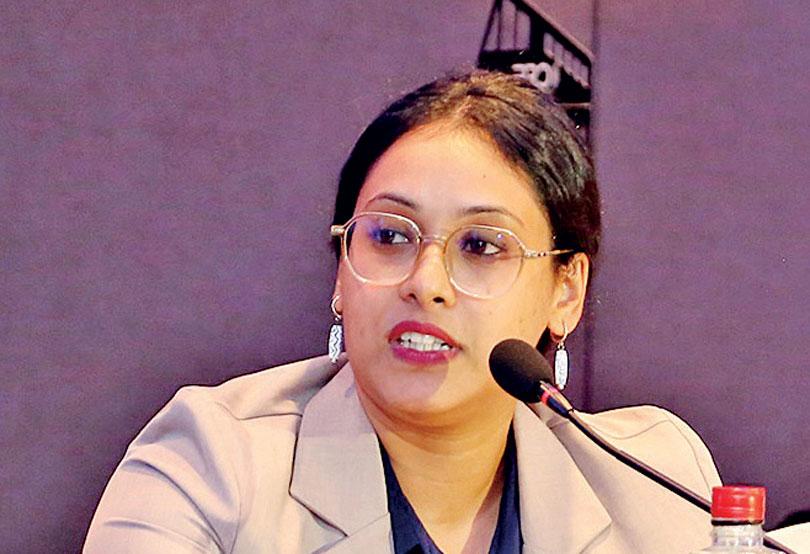
Arutha Co-Founder and Director Rehana Thowfeek
Addressing the structural constraints, Jafferjee argued that debt sustainability fundamentally hinges on the relationship between real interest rates and real economic growth. For debt to remain manageable, real growth must exceed real interest rates. Achieving this requires the economy to expand by at least 5 percent annually to generate revenue through natural fiscal buoyancy.
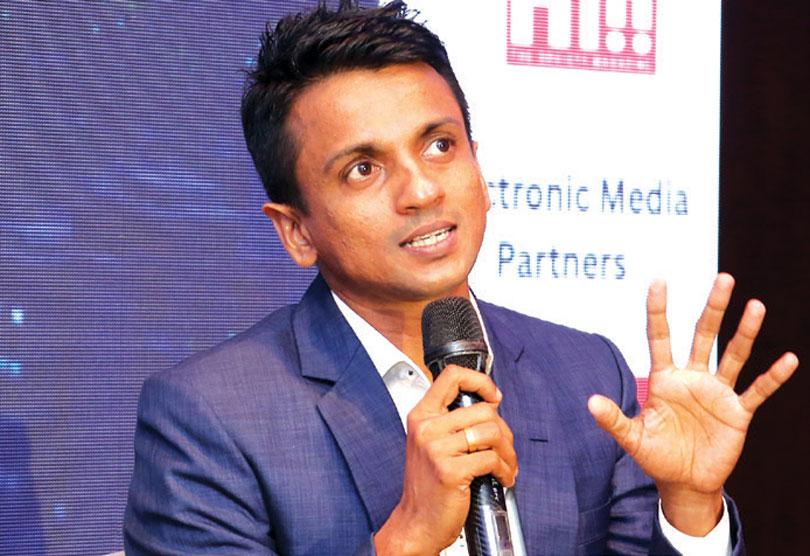
Advocata Institute CEO Dhananath Fernando
However, Jafferjee warned that policy formulation has long been captured by concentrated cartels, creating a system run for the benefit of roughly 100 families.
“The main determinant of productivity is competition. And I’ve said this many times, that the country is governed for 100 families. This is a figurative statement, not a literal statement but all over the place when you look at how policies are framed, formed and implemented, it is for vested interests,” Jafferjee stated.
“Our biggest challenge in Sri Lanka is how we are going to overcome the vested interests, who are very deep.”
Jafferjee’s earlier proposal to rationalise public holidays met immediate pushback during the panel discussion.
Thowfeek stated, “I understand the economic argument on the holidays but as a true and proper Sri Lankan, I must vehemently oppose this idea of taking away our public holidays.”
Thowfeek emphasised that discussions on productivity must account for severe household strain, reminding the panel that real wages have fallen by roughly 30 percent compared to the pre-crisis levels. The audience members pressed the point further from the floor, citing a World Economic Forum report on Sri Lanka’s widening gender pay gap and the strain facing the public sector households earning below Rs.100,000 a month.
Dr. de Mel expanded this into a philosophical critique of modern economic policy, warning against confusing means with ends.
“We mustn’t confuse means and ends. The point of growth is for us to live better lives and for the flourishing of humans and the planet. Growth doesn’t become the master; it must become the servant. And as economists, we often forget that. We start worshipping growth but not the outcomes on human lives,” Dr. de Mel argued.
“Holidays are good for better lives. We must do the productivity that Murtaza talks about and then figure out how to still live better and function better. Growth that doesn’t make the lives of the majority better off ends up, like in lots of places, biting back, even on those who benefit from that kind of growth,” he added.
Dr. de Mel also criticised the absence of official poverty tracking, pointing out that while Sri Lanka’s poverty headcount doubled to nearly 30 percent during the crisis, the authorities have failed to publish systematic measures.
“What you fail to measure, you fail to focus on. All through the crisis we still have not published a poverty measure,” Dr. de Mel stressed, echoing Jafferjee’s earlier point on how deeply wage compression has cut into formal sector incomes.
He urged the corporate leaders to look beyond transactional lobbying and advocate for a national development plan focused on genuine human flourishing.
Democracy, capital and path forward
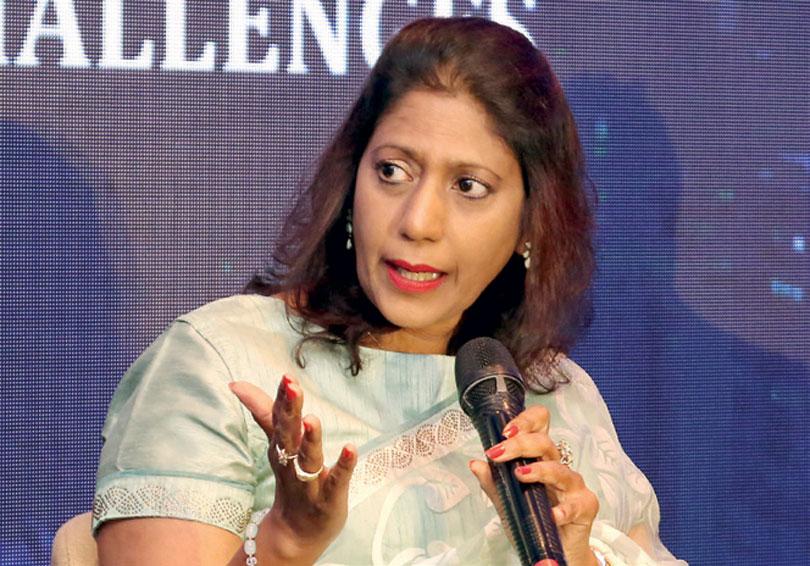
Global Consulting Company CEO Aroshi Nanayakkara
The debate subsequently shifted towards governance structures and capital requirements.
Nanayakkara questioned whether five-year democratic election cycles hinder long-term economic planning when compared to centralised Asian governance models that execute multi-decade visions.
“I’m going to challenge saying, is democracy the right way to go? Every five years when you have a new president coming in and a whole new Parliament coming in, how are you going to maintain that vision for a country?” Nanayakkara asked.
She also disputed the premise of capital shortages, adding: “I completely agree with Murtaza; we don’t need capital. I’m from the banking sector; there’s a lot of liquidity out there and there’s a lot of money, capital, which is not getting deployed where it should be deployed. We really do not need foreign capital coming in but we need that knowledge base coming in from foreign markets.”
Mannakkara delivered a robust rebuttal, defending both foreign capital and democratic governance.
“We are entering a new economy; it’s really akin to the Industrial Revolution, where the growth is very capital intensive and we are seeing one of the largest phases of investment globally right now. To then imagine that Sri Lanka can somehow operate in an inter-economy ecosystem outside this global norm is crazy. So, we do need that,” Mannakkara said.
“International capital also forces governance. With that capital comes knowledge anyway and international capital will help reduce interest rates domestically because of the liquidity that it brings.”
He cautioned against authoritarian alternatives, adding: “While it’s tempting for us to rubbish the public sector and to question the value of democracy, I think these are really dangerous things to say. Because democracy is the ultimate safety valve. Yes, it’s messy; yes, it’s annoying but it’s what gives us resilience.”
As the forum concluded, the participants agreed that Sri Lanka must capitalise on its current stabilisation window before the debt service obligations escalate. Murtaza Jafferjee concluded by citing John F. Kennedy’s adage: “The time to repair the roof is when the sun is shining.”
While acute financial panic has receded, addressing the underlying structural weaknesses—spanning fiscal distortions, credit rating constraints, protectionist policy capture, implementation paralysis, demographic imbalances and weak export complexity—remains essential to securing sustainable, inclusive prosperity for the entire nation.