

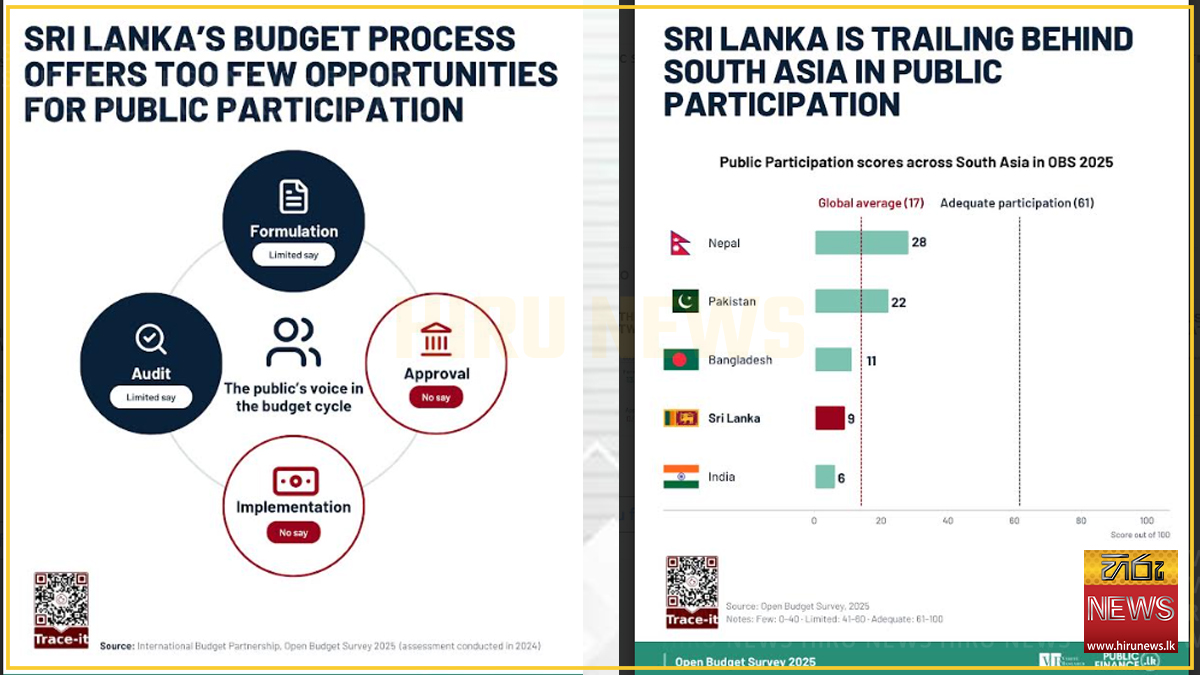
Sri Lanka scores just 9 out of 100 for public participation in the Open Budget Survey 2025. The score points to a basic weakness in the country’s budget process: there are too few formal opportunities for the public to contribute to decisions about how public money is raised, allocated, and spent.
‘Across the four stages of the budget cycle—formulation, approval, implementation and audit—Sri Lanka provides avenues for public input only during formulation and audit,’ says Verité Research.
There is no formal mechanism for participation during parliamentary approval or budget implementation. Even where opportunities exist, they remain limited in scope and are not consistently supported by clear rules, inclusive outreach or feedback on how public input was considered.
While in more recent years, Sri Lanka has strengthened the disclosure of budget information (particularly following the enactment of the Public Financial Management Act, No. 44 of 2024), the institutional arrangements for enabling the public to participate in budget decisions remain weak.
The International Budget Partnership’s Open Budget Survey (OBS) assesses national budget systems across three dimensions: transparency, public participation and oversight. The 2025 survey, based on assessments conducted in 2024, gave Sri Lanka scores of 43 for transparency, 56 for oversight and 9 for public participation; each one out of a possible 100.
The public participation score assesses whether the public has opportunities to participate at all four stages of the budget cycle, and whether the mechanisms available are broad, predictable, transparent, and inclusive.
Sri Lanka’s score reflects substantial gaps across the stages of the budget cycle, with opportunities only present at the budget formulation and audit stage. During budget formulation, the Ministry of Finance publishes an annual notice inviting individuals and organisations to submit proposals for the national budget.
During the audit stage, the National Audit Office accepts public suggestions on subjects for audit, as well as petitions and complaints concerning public entities.
In contrast, there are no formal participation mechanisms during budget approval or implementation.